
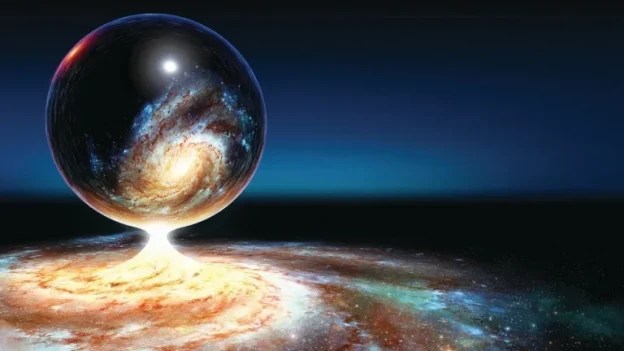
As a neuro-psychotherapist, my work sits at the intersection of science and the human spirit—where rigorous understanding meets the deep need for meaning. One of the most profound scientific puzzles I’ve encountered isn’t in the clinic, but in the cosmos: the cosmological constant (Λ), a term in Einstein’s equations that controls the expansion rate of the universe.
What makes Λ so extraordinary is how precisely calibrated it must be for life to exist at all. If it were slightly larger, the universe would have expanded too fast for galaxies or stars to form. Slightly smaller, and it would have collapsed too soon. The margin for error is incomprehensibly small—about 1 part in 10¹²⁰. That’s a precision comparable to predicting the exact second of a person’s death at the moment of their birth. This isn’t poetic exaggeration. It’s physics.
This extreme fine-tuning has led many thinkers, including myself, to ask: Can such precision really be accidental? Or does it point to intention—perhaps even design?
For many, this level of fine-tuning cannot be dismissed as blind luck. Instead, it points to something deeper—a purposeful configuration of the universe. This is the core of what is often called the design hypothesis: the idea that certain features of the universe are best explained by the existence of an intelligent cause, rather than by chance or necessity.
Simulation, Not Speculation
This isn’t about mystical speculation. We can, and do, simulate alternative universes by altering Λ and other constants. In nearly all these models, the resulting universes are either lifeless voids or catastrophic collapses. Life-permitting universes, like ours, are so rare they occupy a cosmic needle’s eye.
This isn’t theology—its science pointing toward something beyond itself.
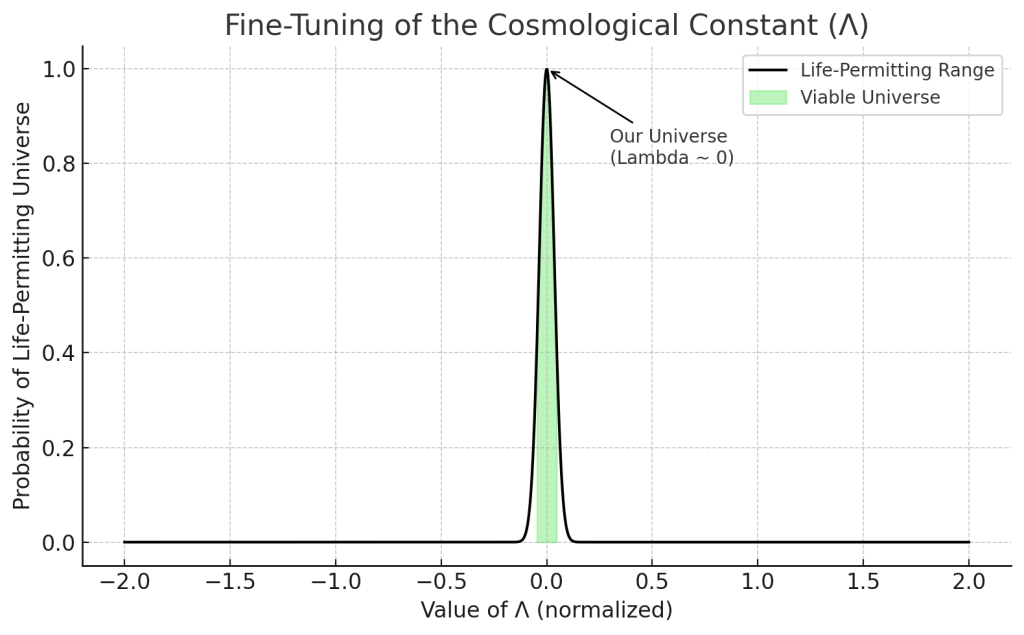
This graph illustrates the extreme fine-tuning of the cosmological constant: only a very narrow range (highlighted in green) allows for a universe capable of supporting life. The vast majority of values outside this range lead to lifeless or unstable universes.
The Design Hypothesis vs. the Multiverse
To avoid implications of design, some propose the multiverse—a theoretical infinity of universes, each with its own laws. In this view, our life-supporting universe is simply the one that “got lucky.”
But this view raises serious philosophical and scientific questions:
- It’s unfalsifiable: We can’t observe other universes.
- It violates Occam’s razor: Why invoke a potentially infinite number of unseen realities to explain the precise conditions of just one?
- It appeals to probability over reason: Relying on cosmic luck when simpler, coherent explanations exist.
The design hypothesis—that the universe was intentionally configured to allow life—is simpler and more parsimonious. It requires fewer assumptions and fits the data we already observe.
The Psychological Lens: Bias and Perception
As someone deeply engaged in understanding how beliefs shape perception, I recognise a pattern here. Critics of design often reject it not because the data are weak, but because of psychological biases—confirmation bias, selective perception, or prior commitment to naturalism.
The irony is striking while design is accused of being “unscientific,” many defenders of the multiverse place faith in unknown future discoveries or hypothetical realms to preserve their worldview. It is not religious belief that drives the design inference—it is the evidence, often resisted because it challenges a preexisting metaphysical framework.
And consider this: if most critics of the design hypothesis identify as agnostic or atheistic, we must ask—are their interpretations truly objective, or are they being shaped by a deeply ingrained worldview? As a psychotherapist, I know how powerfully beliefs guide perception—consciously or not.
A Logical Formulation of the Design Argument
Let’s now distil this into a structured argument:
Premise 1: The cosmological constant is fine-tuned to a degree that is astronomically improbable under random selection.
Premise 2: Simulated variations of Λ overwhelmingly lead to lifeless, nonviable universes.
Premise 3: Of all explanations, intentional calibration (design) is the simplest and most coherent with the observed fine-tuning.
Conclusion: Therefore, the fine-tuning of the cosmological constant is best explained by design, not chance.
The Bridge Between Science and Meaning
In my work, I’ve seen how meaning sustains people through suffering and doubt. And in physics, I see how the universe itself might carry the marks of meaning—not randomness. The fine-tuning of Λ is not just a mathematical fluke. It’s a doorway to a deeper conversation about why anything exists at all, and why consciousness arose to notice it.
The design hypothesis, far from being a retreat into mysticism, may be the most honest interpretation of the evidence, especially when we account for how profoundly psychological filters colour our judgments.
If we are to build bridges between scientific knowledge and spiritual wisdom, then we must be willing to confront not only the data, but the biases that blind us to what that data might be telling us.
Mental Fitness Takeaways from the Cosmological Constant
1. Identify your personal “constant.”
In physics, the cosmological constant maintains balance. What’s the stabilizing value or belief that gives you a sense of structure when life feels chaotic?
2. Don’t fear recalibration.
Einstein revised the value of the constant when new evidence emerged. Similarly, it’s okay to re-evaluate your core beliefs or coping strategies as you grow—flexibility isn’t weakness; it’s maturity.
3. Meaning isn’t fixed—it’s relative.
The “meaning” we give to life events isn’t always inherent—it often depends on perspective, context, and emotional readiness. Being open to reinterpretation can reduce suffering.
Final Thoughts
The cosmological constant may be one of the clearest clues we have that the universe is not an accident. The elegance and precision of the laws of physics point not to chaos, but to coherence; not to randomness, but to reason.
To reject the design hypothesis outright—without engaging with the data, and without considering the psychological biases at play—is not science. It’s dogma in disguise.
If we are to follow the evidence wherever it leads, then the fine-tuning of the universe deserves to be seen not as a cosmic coincidence, but as a cosmic clue.
The cosmological constant stands as a silent sentinel of cosmic order. It invites us not just to understand the universe, but to wonder why it is so precisely fit for us to exist and reflect upon it.
For those of us drawn to both science and the soul, this is not the end of inquiry—it is its beginning.
Discover more from Hypnotic Alliance
Subscribe to get the latest posts sent to your email.
 Hypnotic Alliance