

Introduction
As a psychotherapist with years of clinical experience, I have witnessed a troubling rise in gender dysphoria, particularly among adolescents. This surge is not a natural evolution of human identity, but a psychological crisis fuelled by societal pressures and ideological narratives. My clinical observations, supported by public data, point to a dangerous trend: well-meaning but misguided gender identity policies are amplifying distress in our youth, entrenching maladaptive beliefs, and denying them the opportunity for healing.
In this article, I urge laypeople, educators, policymakers, and influencers to reconsider the push for these policies as a modern crusade and instead prioritize evidence-based approaches that safeguard mental health.
The Myth of Biological Causation
One of the most pervasive claims in the gender identity debate is that gender dysphoria—the distress from a mismatch between one’s body and gender identity—stems from biological factors. Early studies from the 1990s, such as Zhou et al. (1995), suggested differences in brain structures like the bed nucleus of the stria terminalis in transgender individuals.
However, decades of subsequent research have failed to replicate these findings consistently. Neuroimaging and genetic studies, while numerous, have produced mixed or inconclusive results, with no clear biological mechanism explaining the condition. Twin studies hint at heritability, but they fall short of pinpointing specific causes.
The rapid increase in gender dysphoria cases over the past decade further undermines the biological argument. If biology were the primary driver, we would expect a stable prevalence across generations, not a sudden spike concentrated among adolescents.
The data is clear: a 2022 Gallup poll found that 1.8% of Generation Z identify as transgender, compared to just 0.2% of Baby Boomers. This disparity suggests that social and cultural factors, not biology, are at play. To attribute gender dysphoria to innate biological imperatives is speculative and lacks scientific rigor, diverting attention from the psychological and societal roots of this crisis.
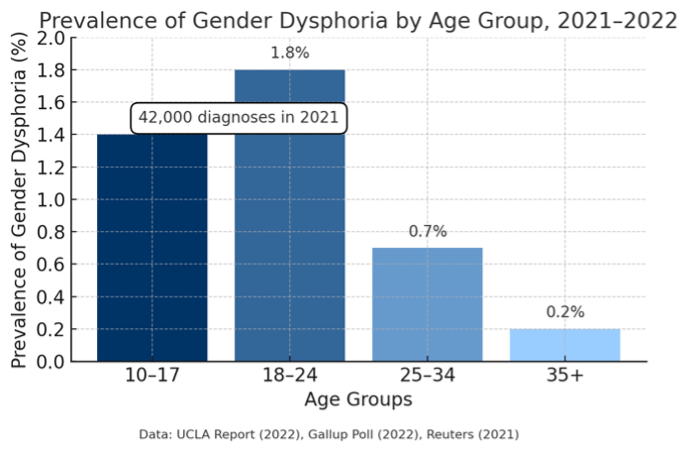
“This chart illustrates the sharp rise in gender dysphoria among adolescents (10–17) and young adults (18–24), with 1.4% and 1.8% prevalence, respectively, compared to just 0.2% in older adults (35+). The 42,000 diagnoses in 2021 for youth underscore the scale of this trend.”
A Psychological Crisis Fuelled by Society
Gender dysphoria, in my clinical experience, often emerges from psychological processes—learned beliefs, social reinforcement, and unresolved emotional conflicts.
Adolescents, who are developmentally vulnerable due to ongoing brain maturation, are particularly susceptible to external influences. Their prefrontal cortex, responsible for impulse control and long-term decision-making, is not fully developed, making them prone to adopting identities shaped by peers, social media, and cultural narratives.
The current societal push for gender identity affirmation acts as a powerful reinforcer, amplifying confirmation bias and providing maladaptive coping for cognitive dissonance. When young people experience distress about their bodies or social roles, the narrative that they are “born in the wrong body” offers a seemingly simple solution.
This is compounded by advocacy that frames gender nonconformity as a social justice issue, encouraging rapid identification with transgender or non-binary labels. In my practice, I’ve seen how these external validations entrench beliefs, making it harder for clients to explore the underlying psychological factors—such as trauma, anxiety, or identity instability—that may contribute to their distress.
Public data supports this view. The Trevor Project (2023) reports that 60% of transgender and non-binary youth experience gender dysphoria symptoms, with the vast majority being adolescents or young adults. This age-specific surge contrasts sharply with other mental health conditions, like ADHD, where increased awareness led to diagnoses across all age groups, including older adults.
If reduced stigma and greater awareness were driving the rise in gender dysphoria, we would see older generations coming forward in similar numbers. Instead, the data points to a phenomenon targeting impressionable youth, who lack the emotional and developmental capacity to discern harmful influences.
The False Promise of Affirmation
Proponents of gender-affirming interventions—such as hormone therapy or surgeries—argue that they alleviate distress. While some studies, like Costa et al. (2015), report short-term improvements in mental health, these outcomes are akin to the temporary mood boost from winning a lottery. They often fail to address the underlying psychological conflicts driving dysphoria.
More concerning, emerging evidence suggests that these interventions, particularly irreversible surgeries, can have devastating long-term effects. A 2021 Swedish study, initially touted as evidence for surgical benefits, found no significant mental health improvement upon reanalysis. Reports of post-surgical regret, though rare, highlight cases where individuals face worsened mental health due to irreversible changes.
As a therapist, I advocate for a different approach: normalizing and exploring the psychological origins of gender dysphoria while validating clients’ experiences. By creating a safe space to examine how beliefs about gender emerged—often tied to social pressures or emotional distress—clients gain insight and develop adaptive coping strategies.
This contrasts with affirmation-only models, which may reinforce maladaptive beliefs and bypass deeper therapeutic work. The societal push to affirm identities without scrutiny risks entrenching distress, denying youth the chance to reframe their experiences in ways that promote long-term resilience.
A Call to Action: Protect Our Youth
The current crusade to promote gender identity policies as a form of social progress is harming our youth. By framing gender dysphoria as an innate truth requiring affirmation, we are amplifying psychological suffering, not alleviating it. Educators, policymakers, and influencers must recognize their role in shaping cultural narratives and exercise caution.
Instead of championing ideologies that reinforce distress, we should prioritize evidence-based mental health support that addresses the root causes of gender dysphoria.
Here’s how you can help:
- Question the Narrative: Encourage critical discussions about gender identity, emphasizing psychological and social factors over unproven biological claims.
- Support Exploratory Therapy: Advocate for therapeutic approaches that explore the origins of distress without rushing to affirm or deny identities.
- Protect Vulnerable Youth: Push for policies that safeguard adolescents from irreversible interventions until they have the developmental maturity to make informed decisions.
- Foster Resilience: Promote environments that help young people build emotional resilience and navigate identity exploration without rigid labels.
As a society, we must stop contributing to the distress of our youth. By grounding our approach in evidence and compassion, we can help them find paths to healing that honour their experiences while fostering long-term mental health.
Let’s move away from ideological crusades and toward a future where our children are supported, not harmed, by the narratives we create.
Mental Fitness Takeaways from The Gender Dysphoria Surge:
1. Question Unproven Biological Claims
Biology may not be the primary driver of the recent spike in youth gender dysphoria—scrutinise the mixed and inconclusive neurobiological research and focus instead on the social and psychological factors at play.
2. Delve Into Psychological Origins
When adolescents experience distress about their bodies or roles, explore underlying learned beliefs, trauma, and cultural narratives rather than immediately assigning identity labels.
3. Protect Developmental Vulnerability
Young people’s prefrontal cortex (impulse control and decision-making) isn’t fully mature—avoid endorsing irreversible medical interventions until they’ve reached sufficient developmental readiness.
4. Build Emotional Resilience
Foster environments that encourage identity exploration, adaptive coping strategies, and critical discussion, rather than rigid labels, to support long-term psychological well-being.
Discover more from Hypnotic Alliance
Subscribe to get the latest posts sent to your email.
 Hypnotic Alliance